Anyone who runs a business already watches the power bill closely. The valley’s long cooling season gets most of the attention, but LED office lighting in Las Vegas is often a bigger and easier target for savings than most owners realize, since the lighting running overhead for eight, ten, or twelve hours a day adds up fast. It is also something employees notice every single day, whether they can put a finger on it or not.
If your office, retail space, or warehouse is still running older fluorescent tubes, metal halide fixtures, or a mismatched patchwork of upgrades over the years, moving to LED is one of the more straightforward improvements a Las Vegas workplace can make. Here is what actually changes, what it involves, and what local businesses should know before scheduling one.
Why Las Vegas Businesses Are Rethinking Their Lighting
Older lighting technology wastes most of the energy it draws as heat rather than usable light, and in a climate where the air conditioning is already working overtime, that extra heat load adds up twice: once on the lighting circuit and again on the cooling system pulling double duty to remove it. According to the U.S. Department of Energy, LED fixtures use up to about 90 percent less energy than incandescent lighting and a meaningful amount less than fluorescent and metal halide technology as well, which is why LEDs made up roughly 30 percent of general illumination installations nationwide as of the Department’s most recent adoption figures, with outdoor fixtures like parking lot lighting converting even faster than indoor spaces (Department of Energy, LED Adoption Report).
That gap between outdoor and indoor adoption is worth noting for commercial LED lighting in Las Vegas specifically, since many offices and retail buildings around the valley converted their parking lot and security lighting years ago but never got around to the fixtures inside. That leftover indoor lighting is usually the highest-opportunity part of the building left to address, and it is where most of the demand we see for energy-efficient lighting in Las Vegas is actually coming from.
More Than a Utility Bill: How Workplace Lighting Affects the People Under It
Lighting is not only an operating cost. Workplace lighting shapes how employees feel and perform during the workday. Research from UNC Kenan-Flagler Business School points to lighting color temperature as a real factor in workplace comfort and output: cooler, blue-toned light in the 4,600 Kelvin range tends to support alertness and idea generation, which makes it a good fit for open work areas, while warmer tones closer to 3,000 Kelvin suit smaller, more relaxed spaces, and a mid-range tone works well in conference rooms where a balance of focus and approachability matters (UNC Kenan-Flagler, How Lighting Affects Productivity). The same research also points to natural light exposure as a factor in mood and energy, which is worth keeping in mind when planning fixture placement near windows.
None of this means every business needs a fully programmable, time-of-day lighting system. It does mean that an LED office lighting project is a chance to match the right color temperature to the right space instead of defaulting to whatever the building came with, which is often a single, uniform, cool-white tube that was never chosen with the workspace in mind.
What an LED Office Lighting Upgrade Actually Involves
Compare LED replacement lamps, retrofit kits and new fixtures in our Las Vegas LED lighting upgrade guide.
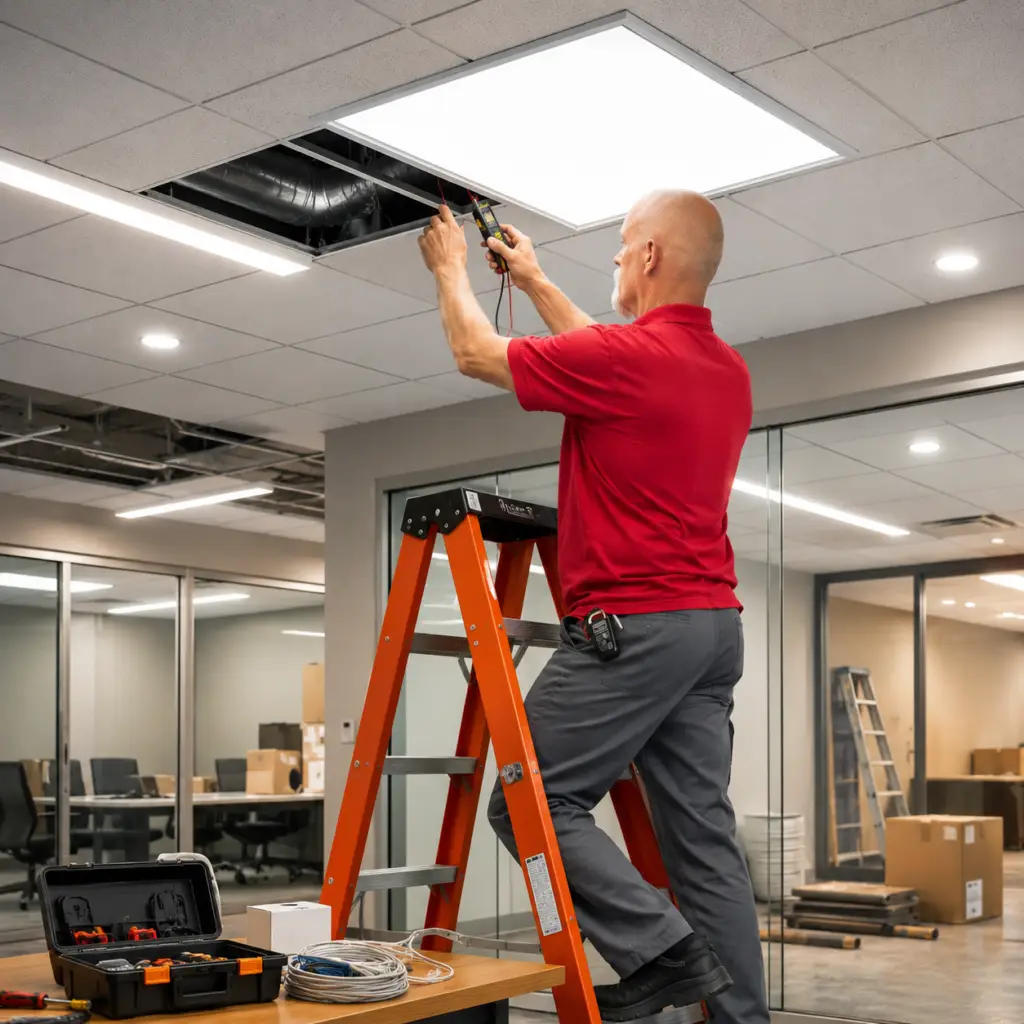
There is more than one way to get a commercial space onto LED, and the right approach depends on the building and the budget. Some businesses ask about a complete LED lighting package for Las Vegas properties covering every fixture at once; others prefer to phase the work room by room.
Full fixture replacement gives the cleanest result and the most design flexibility, particularly in spaces with visible or outdated housings. Retrofit kits are a middle option, keeping the existing housing in place while swapping the internal components for LED, which lowers cost while still updating the technology. Simple LED replacement lamps, including corn bulbs built to fit older high-bay housings, are the least invasive option and a reasonable fit for spaces where the fixtures themselves are still in good shape. We walk through these approaches, along with indoor and outdoor fixture options, in more detail on our LED lighting upgrades page.
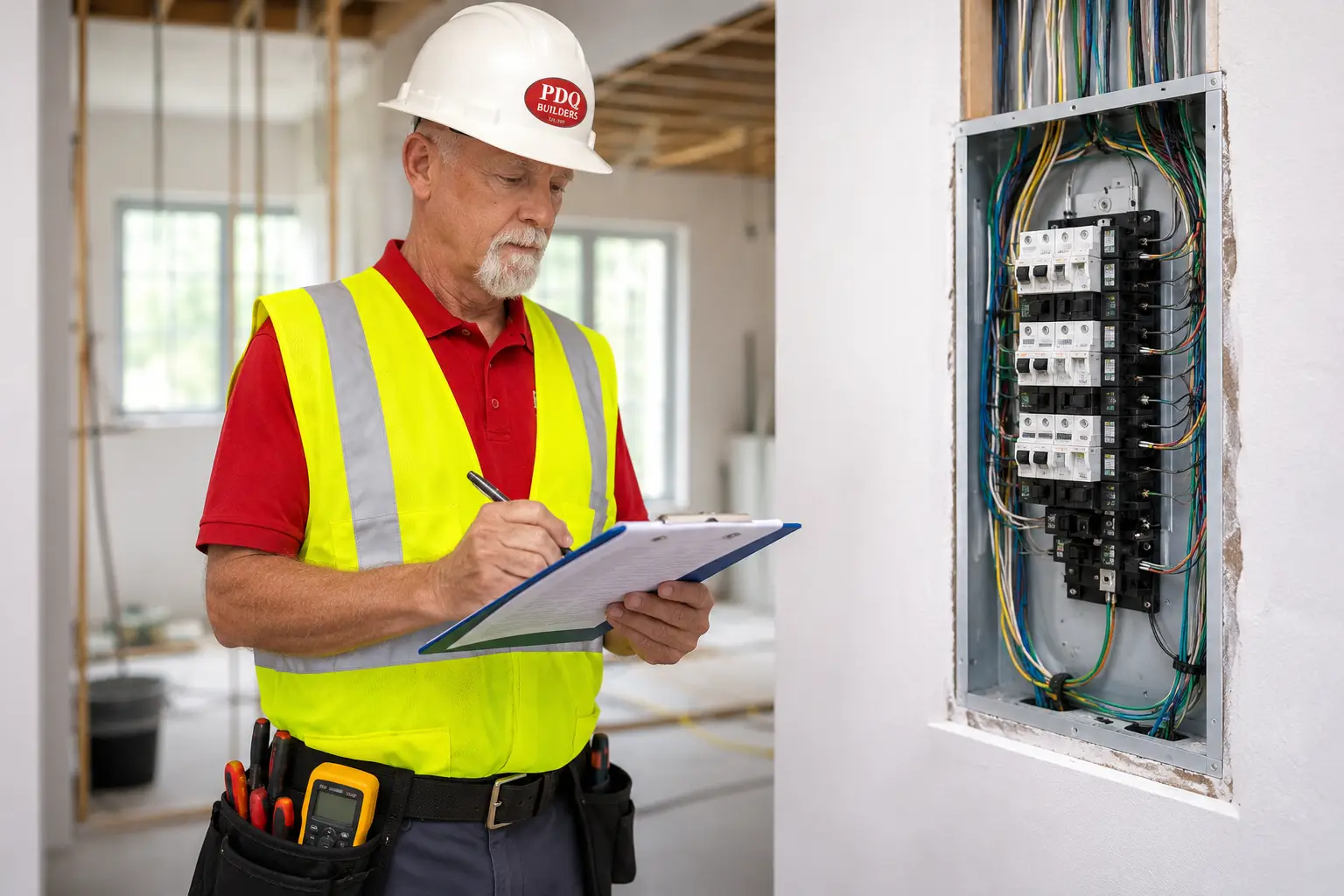
Commercial and office spaces also come with considerations a residential retrofit does not: three-phase power and higher-voltage circuits in larger buildings, panel capacity that needs to be checked before adding or changing fixture loads, and current code requirements that any licensed electrician doing this work needs to account for. Our commercial electrical services page covers the broader systems side of that work, from panel evaluations to tenant improvement wiring, which often comes up alongside a lighting project in an older building.
Exterior lighting is worth planning alongside the interior work rather than as an afterthought. Parking lot and security lighting are usually the fixtures with the longest daily runtime on the property, which makes them one of the faster payback opportunities in a full upgrade.
Local Incentives That Can Offset the Cost
Nevada businesses do not have to cover the full cost of a lighting upgrade out of pocket in every case. NV Energy’s Business Energy Services program offers cash incentives for qualifying commercial customers who upgrade to more energy-efficient lighting, and in some documented cases has covered a substantial share of total project cost once rebates and the resulting energy savings are factored together. Examples published by the University of Nevada, Reno’s Business Environmental Program describe Nevada businesses seeing tens of thousands of kilowatt-hours in annual savings from lighting-focused upgrades, with payback periods around a year in some cases (UNR Business Environmental Program, NV Energy BES Incentives).
Every building and usage profile is different, and rebate amounts and eligibility depend on the specific program terms in effect at the time of application, so these figures are examples of what other Nevada businesses have seen rather than a promise of a specific result for any one property. Funding for these programs is also limited and can change from year to year, which is one more reason to get a project scoped and quoted sooner rather than later if a rebate is part of the plan.
Signs Your Office Lighting Is Overdue for an Upgrade
Every building is different, and the right combination of fixture type, color temperature, and layout depends on how a space is actually used day to day. A licensed electrician can walk the property, take stock of the current lighting and panel capacity, and lay out options at different price points before any work begins. We provide commercial lighting service across Las Vegas, handling both the lighting design and installation side of these projects and the electrical work that supports them, including panel and load evaluations for larger commercial buildings, through our lighting installation services. If you would like a straightforward look at what an upgrade would involve for your space, reach out to schedule a consultation.
Frequently Asked Questions
How much does an LED office lighting upgrade cost in Las Vegas?
Cost depends on the number and type of fixtures, whether the project uses full replacements or retrofit kits, and the building’s existing electrical capacity. A licensed electrician can provide a project-specific quote after seeing the space, and any available NV Energy rebate can be factored into that estimate.
Will the upgrade disrupt our business during work hours?
Most commercial lighting projects can be scheduled in phases or after hours to minimize disruption, especially for retail spaces, offices, and other businesses that need to stay open during the workday. This is worth discussing when the project is scoped.
Are LED lighting upgrades eligible for rebates in Nevada?
Many commercial lighting upgrades qualify for incentives through NV Energy’s Business Energy Services program, though eligibility depends on usage levels and current program terms. A contractor familiar with the paperwork can help confirm what applies to a specific property.
What color temperature is best for an office?
It depends on how the space is used. Cooler, blue-toned light generally suits open work areas and spaces where focus and alertness matter most, warmer tones fit smaller or more relaxed rooms, and a mid-range tone works well in conference rooms and shared spaces.
How long do LED fixtures last compared to what we have now?
LED fixtures commonly run 30,000 to 50,000 hours or more before needing replacement, according to Department of Energy figures, compared to a fraction of that for older fluorescent and incandescent technology. That translates into far less time spent on bulb changes and fixture maintenance over the life of the system.