Picture this: framing is up, the concrete is cured, and the crew is ready to roll. Then someone realizes the electrical permit for the new build hasn’t been pulled yet. Suddenly, the whole timeline is sideways, the GC is fielding calls, and nobody’s having a good morning. Sound familiar? Getting new construction electrical wiring in Las Vegas right from the permit desk to the rough-in inspection doesn’t have to feel like defusing a bomb. It just requires knowing the rules before the first wire gets touched.
This checklist covers every critical phase: permits, panel sizing, rough-in requirements, inspection sequencing, and the specific code details that Clark County inspectors actually look for.
New construction electrical wiring in Las Vegas requires a residential electrical permit before work begins, compliance with the 2023 NEC and Southern Nevada Amendments, a passed rough-in electrical inspection before drywall, and a properly sized panel. Jurisdiction matters: the City of Las Vegas, Clark County, Henderson, and North Las Vegas each have their own building departments. Get a licensed electrician involved at the blueprint stage. Don’t skip the checklist below.
Why Las Vegas Electrical Wiring Isn’t “Standard” Anywhere Else
New home electrical rough-in in Las Vegas is not a one-size-fits-all process. The desert climate, aggressive energy loads from HVAC systems, and a layered jurisdictional landscape make Southern Nevada one of the more demanding markets for residential construction electricians.
Think of it like ordering coffee in a city you’ve never visited. You assume it’ll be simple, and then someone asks you seventeen questions you weren’t ready for.
Las Vegas is not a single permitting jurisdiction. Las Vegas is part of Clark County, but different cities and towns may have specific regulations. The City of Las Vegas, Clark County (unincorporated areas), Henderson, and North Las Vegas each maintain their own building departments and code cycles.
Knowing which one governs a specific build is step zero everything else flows from there.
Step 1: Lock In the Right Code Cycle Before Pulling a Permit
Building codes in the Las Vegas metropolitan area are adopted regionally through the Southern Nevada International Code Council (SNICC), which coordinates code adoption across the City of Las Vegas, Clark County, Henderson, North Las Vegas, Boulder City, and Mesquite.
Clark County adopted the 2024 International Building Codes effective January 11, 2026. All permit applications filed from that date forward must comply with the 2024 codes.
And the adopted codes include the 2023 National Electrical Code (NEC) and the 2024 International Residential Code (IRC) with Southern Nevada Amendments.
So yes that code book from a few years ago might already be out of date. Worth double-checking before finalizing any plans.
Step 2: Pull the Residential Electrical Permit in Las Vegas
No permit, no inspection. No inspection, no certificate of occupancy. It really is that simple and that consequential.
Any electrical installations in new construction will require a permit. This type of work involves significant changes to a home’s electrical system, which must be reviewed by local authorities to ensure safety and compliance with building codes.
Permits are not designed to hinder a project but rather as a safeguard to protect the public health, safety, and welfare. Permits must be pulled prior to commencing any work for which a permit is required.
Clark County permits are valid for 180 days from the date of issuance. If work doesn’t begin within this period, the permit may expire.
Don’t let that clock run out.
To obtain the permit,
builders should submit an application detailing the scope of the work, plans or diagrams if applicable, and sometimes even calculations or specifications. A licensed electrician will often handle this process, ensuring that all paperwork is in order and that the work complies with local regulations.
Step 3: Blueprint-Stage Electrical Planning
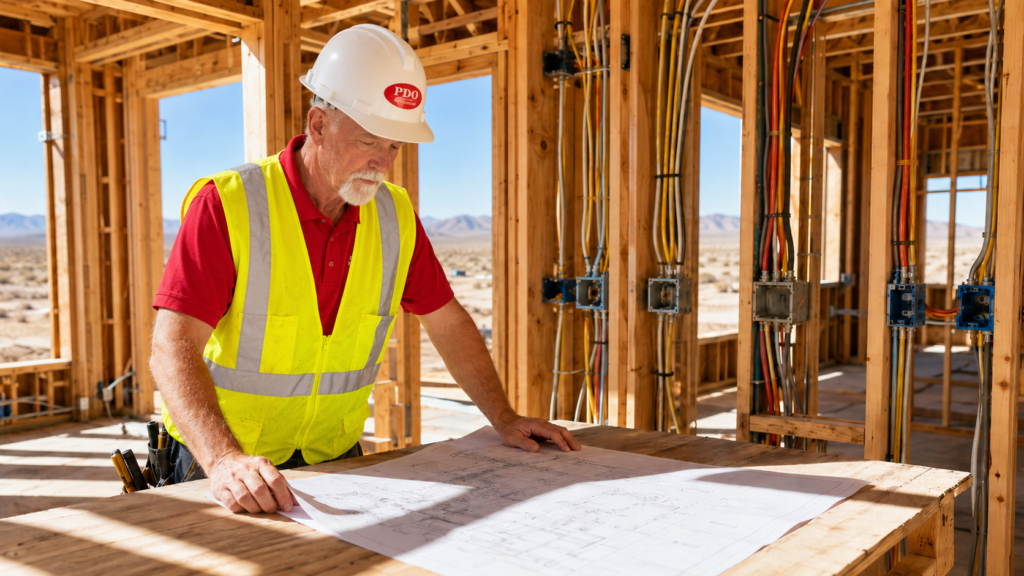
The most expensive electrical mistakes in custom home wiring happen before a single staple is driven. Blueprint-stage electrical planning is the foundation of a clean rough-in. At this phase, the team should be coordinating panel location, service entry point, load calculations, circuit counts, and future-proofing for EV charging and solar.
This is the equivalent of measuring twice before cutting. Skipping this step is how builders end up relocating panels mid-build which is neither cheap nor fun.
Step 4: Panel Sizing for New Homes in Nevada
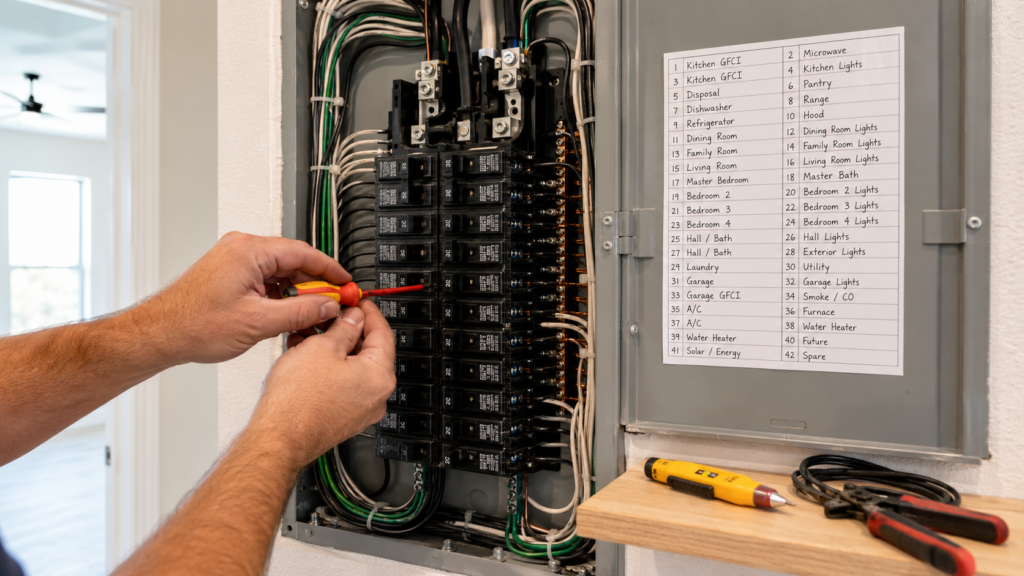
Panel sizing for a new home in Nevada depends heavily on the home’s square footage, appliance loads, and future-proofing needs.
Most homes benefit from 200-amp service, especially with modern appliances, HVAC systems, and EV chargers. Larger homes or those with multiple high-demand systems may require 300–400 amps.
Las Vegas homes run air conditioning hard often for eight or nine months a year. That load matters enormously when calculating service size.
A licensed electrician should carefully calculate the expected electrical load to install a system that safely powers the property for decades to come, providing the foundation for future system expansion.
Don’t undersize a panel and call it a day. The desert has a way of proving that decision wrong every summer.
Step 5: The Electrical Rough-In Checklist for Nevada Builds
This is where the real work and the real inspector scrutiny lives.
Before a single wire is pulled, the team needs to understand which jurisdiction governs the build, which code cycle applies, and exactly what the inspector will be looking for on rough-in day.
Here’s what Las Vegas and Clark County electrical codes specifically require during rough-in:
Wiring and Circuits
No more than twelve (12) duplex receptacles are allowed per 20-amp circuit.
In kitchens of dwelling units, the code requires at least two (2) small appliance circuits serving counter-top receptacles.
No space on kitchen counter tops shall be more than 24 inches measured horizontally from a receptacle outlet.
GFCI and AFCI Protection
All receptacles in garages, bathrooms, outdoor crawl spaces, unfinished areas of basements not intended as habitable rooms, kitchen areas within 6 feet of sinks, boathouses, bathtubs or shower stalls, and laundry rooms shall be GFCI protected.
Arc-fault circuit interrupter (AFCI) protection is required for all 120-volt, single-phase, 15- and 20-ampere branch circuits supplying outlets in dwelling unit kitchens, family rooms, dining rooms, living rooms, bedrooms, recreation rooms, closets, hallways, laundry areas, and similar rooms or areas.
Smoke and Carbon Monoxide Detectors
Smoke detectors in new construction must be hardwired with a battery backup.
An approved carbon monoxide alarm shall be installed outside of each separate sleeping area in dwelling units having fuel-fired appliances.
Lighting and Switches
An outside light is required at every entrance into a dwelling unit. A switch is also required within a 6-foot distance to a doorway that will turn on a light or a switched receptacle in that room.
Conduit and Box Rules
Plastic outlet boxes are not allowed in firewalls unless UL listed and rated.
PVC water piping is not allowed as conduit for electrical wiring.
Step 6: Passing the Clark County Rough-In Electrical Inspection
The rough-in inspection is not a formality. It’s the last chance to catch problems before drywall buries everything.
No wiring shall be covered up by insulation or sheet rock until a rough electrical inspection has been approved.
That’s not a suggestion, it’s code. Covering wiring before approval means tearing it back out.
The typical inspection sequence is: foundation, framing, MEP rough-ins, insulation, drywall, and final.
Electrical rough-in falls squarely in that MEP (mechanical, electrical, plumbing) phase. Everything must be in sequence.
The permit must be visibly posted at the job site
when the inspector arrives. Small detail. Surprisingly easy to forget on a busy build.
If something doesn’t pass,
builders will receive feedback via the portal and need to revise and resubmit.
And in Clark County, a failed inspection comes with a reinspection fee motivation enough to get it right the first time.
Step 7: Final Inspection and Meter Tag
The home isn’t fully energized until the final inspection clears.
The electric meter tag is issued by the building inspector upon completion of an approved final building inspection. To receive a meter tag prior to this time requires approval of a Temporary Power Application.
Every phase from rough-in to final must meet inspection requirements without delays.
The final walkthrough checks everything: panel labeling, fixture installation, outlet covers, exterior lighting, and detector placement. It’s the finish line but only after every box on this checklist is ticked.
FAQ: New Construction Electrical Wiring in Las Vegas
Q: Do I need a separate electrical permit for new construction in Las Vegas, or is it included with the building permit?
A separate residential electrical permit is typically required in the Las Vegas Valley.
The City of Las Vegas has specific construction regulations outlined by its Building & Safety Resources department. These regulations typically cover various aspects of construction, including zoning, building codes, permits, inspections, and compliance requirements.
Always confirm with the specific jurisdiction governing the build address.
Q: Can a homeowner pull their own electrical permit in Clark County?
To obtain a Clark County residential permit, a person does not have to be a licensed contractor. Just about anyone can obtain various permits; however, this does not make them qualified to perform the work for which the permit was pulled.
For new construction electrical wiring, working with a licensed electrician is strongly recommended and often required by lenders and insurers.
Q: What happens if electrical work is done without a permit in Las Vegas?
The consequences are real.
Building owners who do not comply with the laws are issued fines for noncompliance. In addition, they have to remove the inadequate systems and reinstall new systems that meet legal requirements.
Insurance coverage can also be affected, making unpermitted work a very expensive shortcut.
Get the Wiring Right the First Time
New construction electrical wiring in Las Vegas is one of the most detail-intensive phases of any residential build. Between jurisdictional nuances, Southern Nevada code amendments, panel sizing decisions, AFCI and GFCI requirements, and the rough-in inspection sequence, there’s a lot to manage. But when it’s done right, a home’s electrical system runs safely and efficiently for decades with no callbacks, no surprises, no inspector on speed-dial.
Getting it right at the rough-in stage protects the build timeline, client relationships, and the contractor’s license.
That’s three very good reasons to follow this checklist to the letter.
Ready to start a new construction project in the Las Vegas Valley? Work with a licensed Nevada electrician who knows Southern Nevada’s code amendments inside and out. Contact PDQ Electric today to review your plans, pull the right permits, and get your rough-in inspection scheduled before a single sheet of drywall goes up.