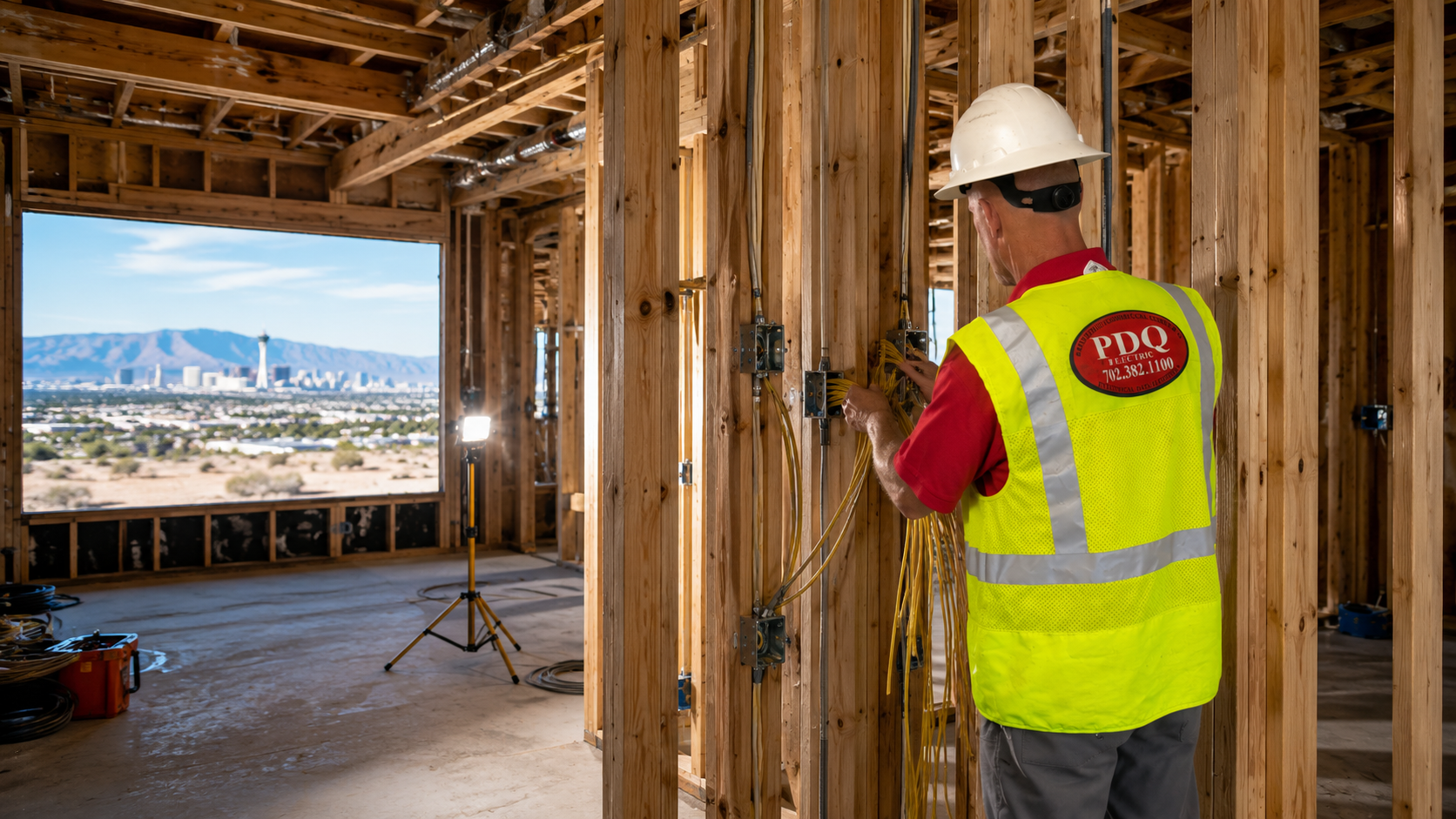
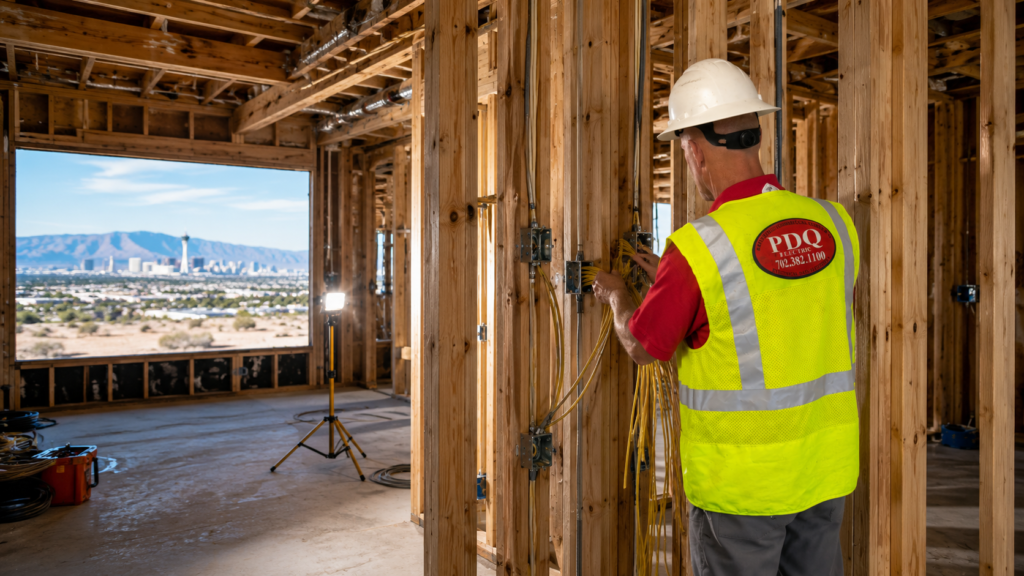
New home electrical rough-in in Las Vegas requires meticulous blueprint-stage planning, strict compliance with Southern Nevada code amendments, and a passed Clark County rough-in inspection before any drywall goes up. This guide walks residential construction electricians and custom home builders through every critical phase from permit pulling to panel sizing so your project stays on schedule and on budget.
Why New Home Electrical Rough-In in Las Vegas Demands a Different Approach
New home electrical rough-in in Las Vegas is not a one-size-fits-all process. The desert climate, aggressive energy loads from HVAC systems, and a layered jurisdictional landscape make Southern Nevada one of the more demanding markets for residential construction electricians. Getting it right at the rough-in stage protects your timeline, your client relationship, and your license.
From suburban developments in Henderson to custom builds across the valley, construction in Clark County comes with unique challenges. The desert climate, rapid population growth, and Nevada’s seismic and energy-efficiency codes all impact how building permits are reviewed and approved.
Before a single wire is pulled, your team needs to understand which jurisdiction governs the build, which code cycle applies, and exactly what the inspector will be looking for on rough-in day.
Understand the Jurisdictional Landscape First
Las Vegas is not a single permitting jurisdiction. This is a critical detail for any residential construction electrician operating in Nevada.
The requirements for electrical permits can vary depending on the jurisdiction within Nevada. Las Vegas is part of Clark County, but different cities and towns may have specific regulations.
The City of Las Vegas, Clark County (unincorporated areas), Henderson, and North Las Vegas each maintain their own building departments and code cycles.
Building codes in the Las Vegas metropolitan area are adopted regionally through the Southern Nevada International Code Council (SNICC), which coordinates code adoption across the City of Las Vegas, Clark County, Henderson, North Las Vegas, Boulder City, and Mesquite. Each jurisdiction votes on local amendments.
This means your custom home wiring in Las Vegas may fall under slightly different amendment sets depending on which side of a jurisdiction boundary you’re building on. Always confirm before you plan.
Current Code Cycles in Effect
Code cycles shifted significantly heading into 2026.
Clark County adopted the 2024 International Building Codes effective January 11, 2026. All permit applications filed from that date forward must comply with the 2024 codes.
The typical inspection sequence is: foundation, framing, MEP rough-ins, insulation, drywall, and final. The adopted codes include the 2023 National Electrical Code (NEC) and the 2024 International Residential Code (IRC) with Southern Nevada Amendments.
Blueprint-Stage Electrical Planning: Start Here
The most expensive electrical mistakes in custom home wiring happen before a single staple is driven. Blueprint-stage electrical planning is the foundation of a clean rough-in.
At this phase, your team should be coordinating panel location, service entry point, load calculations, circuit counts, and future-proofing for EV charging and solar.
If you are constructing a new building or adding a significant extension to your home, any electrical installations will require a permit. This is to ensure that the entire electrical system is designed and installed correctly from the ground up.
Work directly with the architect and HVAC contractor. Forced-air heating systems and major appliances compete for dedicated circuits, and those conflicts are far cheaper to resolve on paper than inside a framed wall.
Panel Sizing and Load Planning
Undersized panels are one of the leading causes of costly change orders in Las Vegas new construction.
Load calculations will be required on your existing service to show room for expansion when more than 12 devices are being added.
For custom builds, plan generously modern households routinely add EV chargers, whole-home generators, and smart-home infrastructure after move-in.
Pulling Permits: What the Clark County Process Requires
No rough-in work should begin without an approved permit in hand.
Electrical permits aren’t just red tape; they’re about safety, compliance, and protecting your investment. Skipping a permit might seem like a shortcut, but it often leads to delays, penalties, or having to redo the work entirely.
You can begin work after the permit is active. Additionally, schedule required inspections via the portal foundation, framing, MEP rough-ins, final, etc.
For Clark County projects, Clark County inspections are scheduled through the Citizen Access portal or by calling 702-455-3000.
For City of Las Vegas projects, inspections are scheduled by calling the Dispatch office at 702-229-6914. Inspections are conducted Monday through Friday, 7:00 AM to 4:30 PM. After-hours, weekend, and holiday inspections are available at an additional charge.
You are required to visibly post the permit at the job site.
Keep approved plans on-site at all times during construction.
Core Rough-In Requirements for Las Vegas Custom Home Wiring
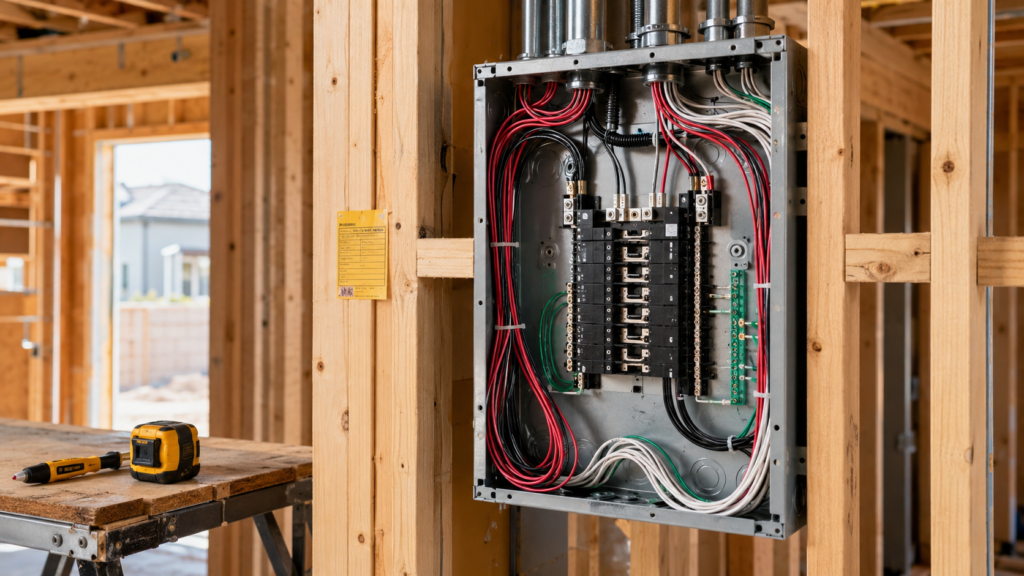
The rough-in stage of construction is when the wiring system is installed and receptacle and lighting outlets are placed throughout the dwelling. This phase covers receptacle outlet spacing, GFCI and AFCI protection, lighting outlet locations, raceway and box fill limitations, box and panelboard installation, equipment grounding, and flexible cords.
Here are the key technical requirements your residential construction electrician must meet before calling for inspection.
Receptacles and Circuit Standards
No. 12 copper wire on a 20-ampere, 125-volt circuit is required on all receptacles.
This is a Southern Nevada-specific amendment that goes beyond base NEC requirements in many other states.
In kitchens of dwelling units, the code requires at least two small appliance circuits serving countertop receptacles. No space on kitchen countertops shall be more than 24 inches measured horizontally from a receptacle outlet.
AFCI and GFCI Protection
AFCI protection is broadly required throughout Las Vegas custom homes.
Arc-fault circuit interrupter protection is required for many 120-volt residential branch circuits. This includes 15- and 20-ampere circuits serving kitchens, family rooms, dining rooms, living rooms, bedrooms, hallways, laundry areas, closets, and similar rooms.
GFCI protection is required for receptacles serving kitchen countertop surfaces. It is also required for receptacles within 6 feet of the top inside edge of a sink bowl, including island counter areas.
Lighting and Safety Device Requirements
An outside light is required at every entrance into a dwelling unit. A switch is also required within a 6-foot distance to a doorway per NEC 210.70(2)(1).
Smoke alarms must be hardwired, interconnected, and equipped with battery backup. They are required on each floor level and in each sleeping room.
Carbon monoxide alarms are required in homes with fuel-burning appliances or attached garages. They must be hardwired, interconnected, installed outside each sleeping area, and placed on every floor level.
The Golden Rule Before Drywall
This cannot be overstated for any residential construction electrician in Nevada:
no wiring shall be covered up by insulation or sheetrock until a rough electrical inspection has been approved.
Failing to follow this single rule is the fastest way to trigger a costly re-inspection and a project delay.
Passing the Rough-In Inspection in Clark County
The rough-in inspection in Clark County is the pivotal gate between framing and closing the walls.
The building inspector’s responsibility is to inspect completed work to verify compliance with the approved plans and the adopted codes of Clark County.
New electrical work and parts of existing systems affected by new work or alterations shall be inspected by the building official to ensure compliance.
Inspectors will verify wire routing, box placement, service panel rough-in, bonding, and protection devices.
If your inspector raises a code interpretation concern, know that
Clark County’s Building Division has a Second Opinion Program. They guarantee a second opinion upon request either on the spot or by calling Inspections at (702) 455-8040 to speak with a supervisor. A second opinion will be provided by the end of the following work day.
FAQ: New Home Electrical Rough-In Las Vegas
Can I start rough-in wiring before my permit is approved in Clark County?
No.
Upon issuance of required permits, construction may begin on your project and inspections conducted. Approved plans and a permit card must be on the job site during all phases of construction.
Starting work without an active permit puts your entire project at risk of stop-work orders and forced removal of completed work.
What happens if my rough-in inspection fails in Las Vegas?
A failed inspection means no drywall until deficiencies are corrected and a re-inspection is passed.
County staff reviews your submission for code compliance, structural, zoning, fire, and other requirements. If corrections are needed, you’ll receive feedback via the portal and need to revise and resubmit.
Budget time for at least one re-inspection cycle on complex custom home builds.
How far in advance should I begin blueprint-stage electrical planning for a Las Vegas new build?
Ideally, your residential construction electrician should be involved during the architectural design phase before permit submission.
Construction in Clark County comes with unique challenges, and knowing which jurisdiction applies to your project and how to navigate the county’s process is essential for keeping your job on schedule.
Early involvement means panel placement, conduit routing, and load calculations are resolved before they become structural conflicts.
Build It Right From the Blueprint Stage
New home electrical rough-in in Las Vegas is both a technical and a regulatory challenge. The best custom home builders in Southern Nevada treat the rough-in phase as an investment in every phase that follows a passed Clark County rough-in inspection means no surprises at final, no re-work, and a client who closes on time.
Start with the right jurisdictional knowledge, hire a licensed residential construction electrician in Nevada who knows the Southern Nevada amendments, and plan your wiring layout at the blueprint stage. The inspection will follow.
Ready to build smarter? Partner with us, your licensed Las Vegas electrician who specializes in new construction rough-in and blueprint-stage planning. Contact us today and get your project scoped before the framing crew arrives.